 475+ Reviews
  530 Business Parkway Ste 2., Royal Palm Beach, FL 33411
 561-779-2650

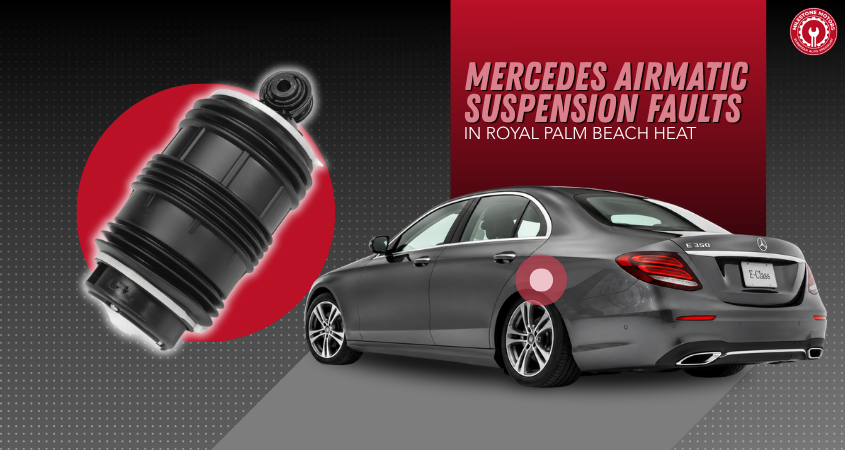
You parked the E-Class at nine. By morning the left rear sits on the bump stop and the dash reads AIRMATIC malfunction. That sag is a torn air spring, and Royal Palm Beach heat finished the rubber off.
Air suspension is not a system you nurse along. AAA research on driving costs puts the average annual price of owning a new vehicle above $12,000, and a leaking Airmatic strut keeps adding to that.
Quick Summary: Key Takeaways
- Rubber fails first: Airmatic bladders crack from heat and UV, often by 60,000 miles in Florida.
- Overnight sag is the tell: One low corner after eight hours parked means a leak.
- The compressor is the victim: A leak makes it run for minutes instead of seconds.
- Replace in pairs: Both struts plus the dryer and relay. Front or rear.
- Common on W211, W212, W221 and W166: E-Class, S-Class, ML and GLE share the design.
Airmatic rides on rubber air springs, and Florida heat attacks them first
Airmatic replaces steel coil springs with a rubber air bladder over each of the four shocks, and an electric compressor, valve block and four ride-height sensors keep the body level. Rubber is the weakness.
That bladder sits inches above hot pavement and bakes all summer, so ozone and Palm Beach County sun harden the rubber until it cracks along the lower crimp. We find split bladders at 60,000 to 80,000 miles on cars parked outside. Garage cars last longer.
Age beats mileage here. Air escapes overnight, the control module wakes the compressor, and that pump keeps cycling until you drive away. A nine-year-old car is the real candidate.
Five symptoms point straight at an Airmatic leak
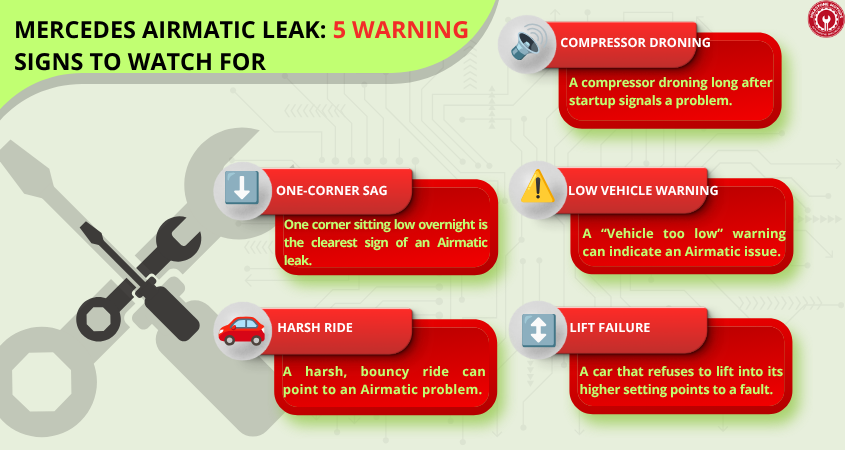
One corner sitting low after the car has been parked overnight is the clearest sign of a leak, and the car usually rises again within a minute of starting the engine. That is not electrical.
Add a harsh, bouncy ride, a compressor droning long after startup, a Vehicle too low warning on the dash, and a car that refuses to lift into its higher setting. Rear-only sag on a W211 wagon usually means the rear springs or valve block.
All four dropping means the pump. If the car sags slowly over three or four days, the leak is still small enough to catch cheaply. That is the version you want to find.
Heat, ozone and rough pavement cause most Airmatic failures we see
Three things kill these systems: aged rubber, moisture inside the air lines, and impact damage from bad pavement, and heat handles the first one all by itself. Moisture comes from the dryer.
Once the compressor desiccant saturates, water reaches the valve block and corrodes the internal seals, which is why we replace the dryer with every strut job rather than reusing it. Patched asphalt on Southern Boulevard and drainage dips on side streets supply the impacts. Potholes finish tired rubber.
Dried rubber splits first. Hit a seam at 45 mph with four people aboard and a tired bladder gives up that day. Nine Florida summers outside beats 110,000 highway miles.
Waiting turns a strut job into a compressor and valve block job
Fix the leak the week you notice it, because the compressor is the part that suffers next. One air spring is a contained repair with a known price. Delay adds parts.
Drive on a fully deflated corner and you also ride on the bump stop, which destroys the shock valving, chews the tire shoulder and loads the control arm bushings. A sagging corner changes ride height, camber and how the car brakes.
Wet Okeechobee Boulevard punishes that. Headlight aim shifts too, so oncoming traffic gets your high beams whether you asked for them or not. None of that is worth a few weeks.
Royal Palm Beach Airmatic diagnosis starts with XENTRY and a real leak test
We pull stored faults from the Airmatic module with Mercedes-level software, then command each corner up and down. How fast a corner bleeds tells us where to look. Then we get physical.
Soapy water on the bladder folds, air line fittings and valve block shows bubbles, and we log compressor run time and current draw to judge whether the pump is already worn. After that we quote the whole job in writing. No surprises.
Struts go in pairs. New dryer, fresh relay, then a ride-height calibration so the car sits level and the lights aim correctly. That is a repair, not a return visit.
Frequently Asked Questions
Q: How much does it cost to replace a Mercedes Airmatic air strut?
A: It varies. Parts choice drives most of the price. A genuine Mercedes strut costs far more than a quality Arnott unit. We quote per corner after inspection and always price the pair, since the second side rarely lasts long on a nine-year-old car that has spent every summer parked outside.
Q: Can you drive a Mercedes with a bad air suspension?
A: Short and slow, yes. Daily, no. A collapsed corner rides on the bump stop, ruins the shock and wears the tire unevenly, and it also keeps the compressor running, which is the part you really do not want to buy.
Q: How long do Mercedes Airmatic air springs last in Florida?
A: Not long. In Palm Beach County we usually see the bladders crack between 60,000 and 80,000 miles, or around eight to ten years. Cars parked outside fail sooner, because UV and ozone attack the rubber even while the car sits still.
Q: Why does my Mercedes sag overnight but rise when I start it?
A: Classic leak. While the car sleeps, air escapes through a cracked bladder or a leaking valve, and nothing refills the system until you turn the key. Start up and the compressor refills the system. The leak is still there, and it grows.
Get your Airmatic tested before the compressor gives up
Do not wait. A sagging corner or an AIRMATIC message deserves attention this week. Send us a message through our contact page and tell us which corner drops and how quickly.
Hours: Mon-Fri 7:30 AM to 5:00 PM; closed Saturday and Sunday
Website: milestonemotorspb.com