 475+ Reviews
  530 Business Parkway Ste 2., Royal Palm Beach, FL 33411
 561-779-2650

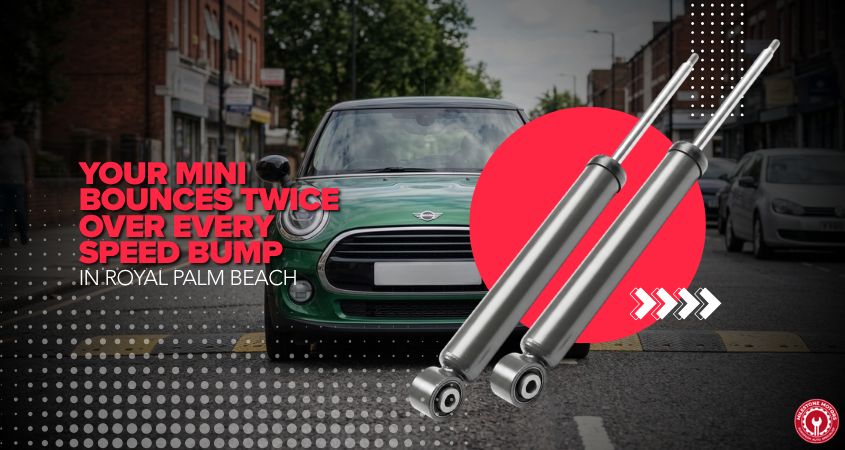
MINIs are supposed to feel tight. So when the back of the car starts floating over the speed bumps in your own community, or slapping hard over the drainage dips on a side street off Okeechobee Boulevard, something in the rear suspension has stopped working.
Usually it is the rear shock absorbers. On a Cooper or Cooper S, the rear dampers are small, they work hard on a short wheelbase, and they wear out quietly enough that most owners adapt to the change instead of noticing it. Dry season is a good time to catch it, before the winter driving miles pile on.
Quick Summary: Key Takeaways
- What a shock does: It does not hold the car up. The spring does that. The shock controls how fast the spring is allowed to move.
- The two-bounce rule: Push down hard on a rear corner and let go. One rebound is normal. Two or more means the damper is finished.
- Look for the oil film: A wet, grit-covered shock body means the seal has failed and the damping oil has left.
- Bump stops matter: The foam stops above the shock crumble with age, and a car riding on crumbled stops crashes over sharp bumps.
- Replace as a pair: One new rear damper against one tired one makes the car behave differently over each side of a bump.
A shock controls the spring, and a MINI leans on it hard
Inside the damper, a piston forces oil through small valves as the wheel moves. That resistance is what stops the spring from oscillating. Take the oil away and the spring keeps doing what springs do, which is bounce.
Short-wheelbase cars feel this sooner. A MINI’s rear axle covers less distance between bumps, so the damper gets less time to settle the body before the next input arrives — one reason a tired rear shock on a Cooper feels worse than the same wear would on a larger sedan.
Rear dampers also live in a hot, exposed place under a small car. Heat thins the oil, seals harden, and after enough Florida summers the seal gives up and the oil weeps out past it.
You can run the first two tests in your own driveway
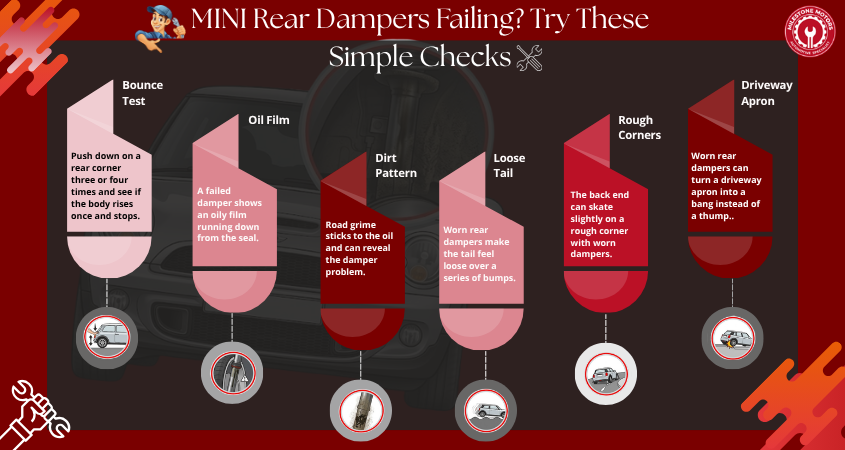
Start with the bounce test. Push down hard on one rear corner, three or four times, then let go at the bottom of a stroke and count what the car does — a healthy damper brings the body back up and stops it there, while a worn one lets the corner rise, drop and rise again.
Then look at the shock body itself. A dry damper is dusty and even in color. A failed one has an oily film running down from the seal, and because oil catches road grime, the dirt pattern usually gives it away before you touch anything.
The third clue is inside the car. Worn rear dampers make the tail feel loose over a series of bumps, they let the back end skate slightly on a rough corner, and they turn a driveway apron into a bang instead of a thump.
Worn dampers scallop your rear tires
When a wheel is allowed to bounce, the tire loses and regains grip dozens of times a second. That pattern gets worn into the tread as cupping — high and low patches around the circumference that you feel with your palm and hear as a rhythmic drone at 45 mph.
Cupped tires are usually blamed on balance or alignment. Sometimes that is right. On a car with 90,000 miles and original rear shocks, it almost never is, and fitting new tires without replacing the dampers just starts the same process over on new rubber.
Rough pavement accelerates all of it. ASCE’s 2025 Infrastructure Report Card found 39% of major U.S. roads in poor or mediocre condition, which is a lot of impacts for a small damper to absorb.
Damping affects how the car stops, not only how it rides
Braking transfers weight forward, and the rear dampers control how quickly that happens. With worn shocks the rear goes light sooner, which lengthens stopping distances on rough pavement and makes the anti-lock system work harder than it should.
You notice it most in the wet. A bump mid-corner unsettles the tail, the car takes an extra beat to recover, and the whole thing feels less planted than a MINI has any business feeling.
So we treat worn dampers as a safety item rather than a comfort one. Ride quality is just the symptom you happen to feel.
What replacement involves on a Cooper
Rear dampers on these cars are a straightforward job with the right lift and the right tools. We replace them in pairs, inspect the bump stops and upper mounts while everything is apart, and fit new stops if the old foam has started to crumble.
We also check the springs for corrosion and the rear trailing arm bushings, because a car that bangs over bumps sometimes has more than one thing loose back there. OEM-quality parts go in, and then we drive the car over the same kind of bump you complained about.
Frequently Asked Questions
Q: How do I know if my MINI needs new rear shocks?
A: Run the bounce test on each rear corner and look for oil on the shock bodies. A corner that rebounds more than once, or a damper with a wet film down its side, needs replacing. Cupped rear tires and a floaty tail back that up.
Q: How long do MINI rear shocks last?
A: There is no set interval, and mileage matters less than conditions. In Palm Beach County heat, on patched pavement and speed bumps, we start finding weeping rear dampers well before the odometer gives owners any reason to suspect them.
Q: Should shocks be replaced in pairs?
A: Yes, on the same axle. A new damper on one side and a ten-year-old one on the other means each rear wheel responds differently to the same bump, which is exactly what you were trying to fix.
Get the bounce checked while it is still just a bounce
A pair of rear dampers is a routine repair. A pair of rear dampers plus two cupped tires is the version that annoys people. Bring the MINI in and we will run the bounce test and show you the shock bodies.
Hours: Mon-Fri 7:30 AM to 5:00 PM; closed Saturday and Sunday
Website: milestonemotorspb.com