 475+ Reviews
  530 Business Parkway Ste 2., Royal Palm Beach, FL 33411
 561-779-2650

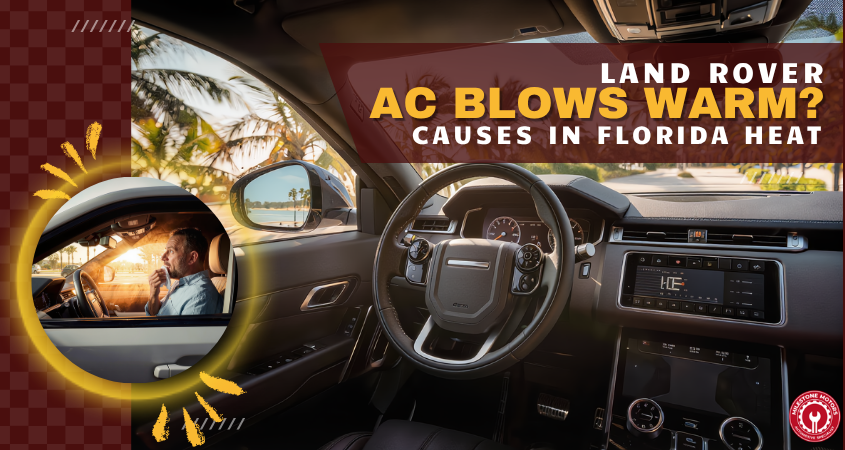
It is 94 degrees on Southern Boulevard and traffic has stopped. The Range Rover vents just went from cold to lukewarm. Reach open road and the cold returns. That pattern narrows the cause to two or three parts.
Weak AC costs you fuel as well, since the U.S. Department of Energy reports that air conditioning can cut a conventional vehicle’s fuel economy by more than 25% under very hot conditions.
Quick Summary: Key Takeaways
- Cold at speed, warm at idle: Points at condenser airflow or a failed cooling fan module.
- Warm on one side only: Almost always a blend door actuator on LR3, LR4 or Discovery.
- Hissing with no cold air: Suggests a leak at the condenser or a line O-ring.
- 2017 and newer use R-1234yf: That refrigerant costs several times more than R-134a.
- Never just top it off: Adding gas without a leak test wastes money and hurts the compressor.
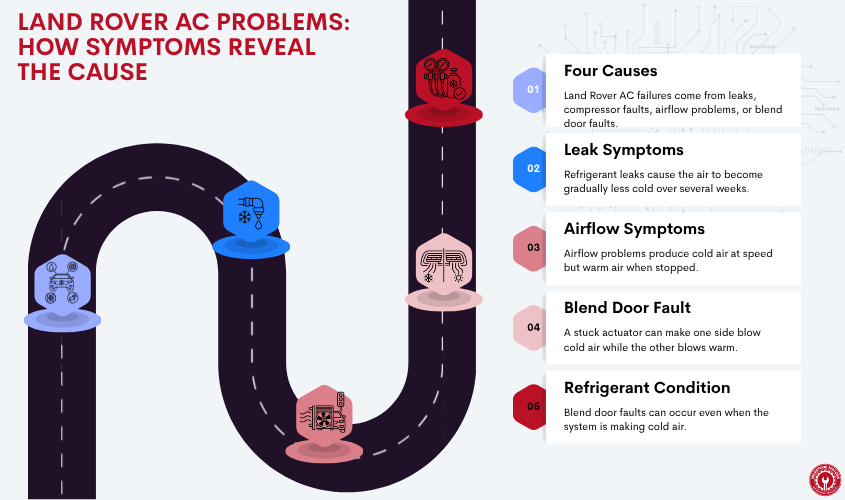
Land Rover AC failures fall into four groups, and the symptom tells you which
Warm air comes from a refrigerant leak, a weak compressor, blocked condenser airflow, or a blend door fault, and each one behaves differently in the driver’s seat. Listen to the pattern.
Leaks give air that grows less cold over weeks, compressor control valve faults come and go with no logic, and airflow problems hand you cold air at 60 mph and warm air at a light. Blend door faults are the strange ones.
The system is making cold air. A stuck actuator mixes heater core air into one side, so the driver vent blows 45 degrees and the passenger vent blows 70. Nothing is wrong with the refrigerant.
Condenser damage and fan failures explain most warm-at-idle complaints
A condenser packed with debris is the number one cause of AC that dies in traffic, and it sits at the very front of a Range Rover behind a grille that swallows grit. Sand and bug debris pack the fins.
At 60 mph ram air pushes through anyway, which is why the vents blow cold on the Turnpike and turn warm the moment you reach a drive-through line. The cooling fan module is the other half.
L322, L320 and L405 models fail these internally, and rock strikes matter too, because a single stone through the lower grille can start a leak that takes six months to show. The tubes are thin aluminum.
Blend door actuators and control modules cause the strangest AC complaints
If one side blows cold and the other blows warm, stop looking at refrigerant, because dual-zone systems use small geared actuators to swing mixing flaps behind the dash. Those plastic gears strip.
LR3 and LR4 owners know the symptom well, because the failing actuator usually ticks behind the dash for the first ten seconds after you turn the key. Land Rover buries several of them above the transmission tunnel.
Labor costs more than the part. Software counts as well, so we run an actuator relearn after replacement instead of bolting in a part and calling it finished. A miscalibrated module commands the wrong flap position. Calibration matters.
Florida heat turns a weak AC system into a stranded weekend
Heat is the load that exposes every marginal seal, tired fan and low charge level, so a system that felt fine in April struggles once ambient hits 90 degrees. Humidity adds more.
The same fan and condenser stack also cools engine coolant, so a fan module that fails in July raises coolant temperature in traffic and shortens the life of every plastic part behind it. Cabin comfort is the symptom owners notice.
Overheating is the expensive one. Refrigerant also carries the oil that lubricates the compressor, so running low for a whole summer wears it from the inside. That turns a hose repair into a system job.
Our Royal Palm Beach AC diagnosis measures pressures before it quotes parts
Every AC job here starts with gauges on both service ports, a vent temperature reading, and a scan of the climate module for faults and live actuator positions. Numbers come first.
If pressures point at a leak, we recover the charge, pull a deep vacuum, hold it, then pressurize with nitrogen and trace the escape with dye or an electronic sniffer. That way we point at one fitting instead of guessing.
No repeat recharges every three months. We service R-134a and R-1234yf systems, which matters on 2017 and newer Velar, Discovery and Range Rover models. The newer refrigerant is a real line item.
Frequently Asked Questions
Q: Why does my Range Rover AC only blow cold when I am driving?
A: That is an airflow problem at the condenser. Either the fins are packed with debris or the electric fan is not moving air at idle. Highway speed forces air through and hides the fault, so the cold returns as soon as you move.
Q: How much does it cost to fix Land Rover air conditioning?
A: It depends on which part failed. A recharge with a proper leak test sits at the low end. A condenser is mid-range, and a compressor or evaporator job is the top end because of labor. We diagnose first, then quote.
Q: Can I add refrigerant to my Land Rover myself?
A: We do not recommend it. If the system is low, gas escaped somewhere. Store cans add sealant and moisture along with refrigerant, and that combination clogs the expansion valve and can kill the compressor.
Q: What does a Land Rover blend door actuator failure feel like?
A: Odd behavior. Uneven temperature side to side, or a temperature dial that changes nothing. Many owners hear repetitive ticking behind the dash for ten seconds after startup. The refrigerant side is usually perfectly healthy.
Book a Land Rover AC diagnosis while the heat is on
Do not wait. Warm vents get worse, never better. Reach out through our contact page, tell us whether the air goes warm at idle or all the time, and we will get gauges on it.
Hours: Mon-Fri 7:30 AM to 5:00 PM; closed Saturday and Sunday
Website: milestonemotorspb.com