 475+ Reviews
  530 Business Parkway Ste 2., Royal Palm Beach, FL 33411
 561-779-2650

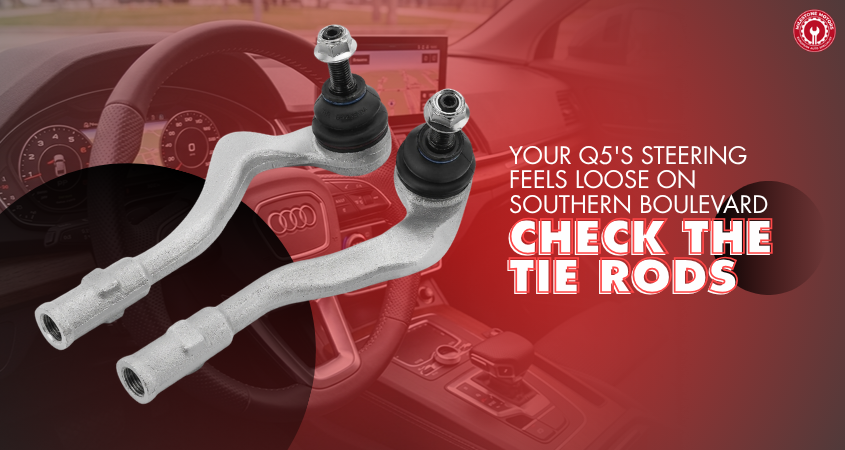
The car does not pull. It wanders. You hold a lane on Southern Boulevard with a series of tiny corrections, the wheel has an inch of nothing in the middle, and over the expansion joints there is a light knock you can feel in your palms more than hear.
That is tie rod wear, and it is the most common steering complaint we see on Audi A4, A6, Q5 and Q7 models in Royal Palm Beach. Dry season is when it gets noticed, because you are back on the highway at speed instead of crawling through August storms. It also happens to be the wear item that quietly ruins a set of front tires.
Quick Summary: Key Takeaways
- What tie rods do: They are the only mechanical link between your steering rack and the wheels, so every bit of slop in them shows up as slop at the wheel.
- Two joints per side: The inner socket lives under the rack boot; the outer end bolts to the steering knuckle. Either can wear, and they wear differently.
- The tell: Vague on-center steering, wandering at highway speed, and a light knock over expansion joints.
- Watch the tires: Feathered edges you can feel with your hand across the tread are the classic sign of toe that will not stay put.
- Toe changes with the repair: Adjusting or replacing a tie rod moves toe directly, so the car needs aligning before it goes back on the road.
Tie rods are the last link between the rack and the wheel
Your steering rack pushes a rod left or right. That rod ends in an inner ball socket, threads into an outer tie rod end, and the outer end bolts to the steering knuckle. Every degree you turn at the wheel travels through those two joints on each side of the car.
Both joints are greased and sealed. Both are meant to have zero free play. Once the grease is gone or a boot has split, the socket wears oval, and now the wheel can move a few degrees before the tire does anything at all.
That is what people mean by loose steering. Nothing is broken. There is simply slack in a system engineered to have none.
The symptoms arrive in a predictable order
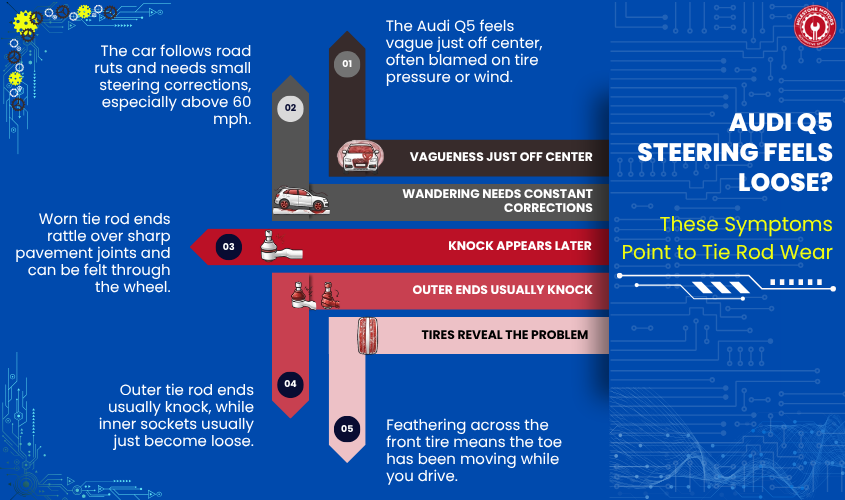
It starts as vagueness just off center, which is easy to blame on tire pressure or a windy day. Then comes the wandering: the car follows ruts on Okeechobee Boulevard and needs constant small corrections to hold a lane, particularly at 60 mph and above.
The knock shows up later. Worn tie rod ends rattle over sharp pavement joints, and you often feel it through the wheel rim before you hear it in the cabin. Outer ends usually knock. Inner sockets usually just go loose.
The tires confirm it. Run your palm across a front tire from the inside edge outward, then back the other way — if it feels smooth one direction and sharp the other, that is feathering, and feathering means toe has been moving around while you drive.
Dry season puts Audi owners back on rough pavement at speed
October changes how Palm Beach County drives. The afternoon storms stop, seasonal traffic builds, and the same patched concrete on Southern Boulevard that you crawled over in August now gets taken at 60. Speed is what turns steering slack into a handling complaint.
The surface underneath is a known quantity. ASCE’s 2025 Infrastructure Report Card puts 30% of Florida’s roads in poor or fair condition, and nationally, deteriorated roads added $725 per motorist in extra operating costs in 2023 according to ASCE’s roads assessment.
Heat plays a part too. Rubber boots that spent a Florida summer baking on hot asphalt crack sooner than boots in a mild climate, and once a boot cracks, the joint underneath it has a countdown running.
Loose tie rods cost you tires long before they cost you safety
Toe is the setting that decides whether your front tires roll straight or scrub sideways a fraction of an inch with every rotation. A worn tie rod lets toe change under load, so the alignment is correct in the shop and wrong on the road.
So the front tires wear out thousands of miles early while the rears look new. Owners replace them, enjoy a month of improvement, then watch the new set feather the same way.
There is a failure end to this as well. A badly worn outer end can separate, and when a tie rod separates you lose steering on that wheel completely. It is uncommon. It is also the reason we do not let a knocking tie rod ride.
How we measure play instead of guessing at it
The dry-park test settles it in minutes. With the car’s weight on the wheels, one technician rocks the steering wheel back and forth a few degrees while another watches each joint under the car, so any movement in a socket that does not translate into movement at the wheel is visible and measurable.
We check the rack boots at the same time, because a torn boot means the inner socket has been exposed to water and grit, and we look at the outer end grease and the knuckle taper. Then we report what we found with the vehicle health check, so you see the same thing we did.
OEM-quality parts go in, and the car gets road-tested at highway speed by ASE-certified technicians.
Frequently Asked Questions
Q: What are the symptoms of a bad tie rod on an Audi?
A: Vague or loose steering just off center, wandering at highway speed, a knock over sharp pavement joints, and feathered wear on the front tires. Uneven wear plus a loose feel is the combination that points hardest at tie rods rather than tires.
Q: How much play in a tie rod is acceptable?
A: None. Both the inner socket and the outer end are designed with zero free play, so any movement you can produce by hand or with a dry-park test is a failed joint. That is why this is a measured inspection and not an opinion.
Q: Do you need an alignment after replacing tie rods?
A: The car does, every time. Replacing or adjusting a tie rod changes toe directly, and driving on incorrect toe will scrub the tread off a new front tire in a few thousand miles. It is not an optional last step.
Q: Can worn tie rods cause vibration at highway speed?
A: They can amplify one. Tie rod wear on its own causes wandering rather than a steady shake, but slack in the steering lets an out-of-balance wheel or a cupped tire feel far worse than it should.
Get the steering checked before season traffic starts
Loose steering is easy to live with and expensive to ignore. A pair of tie rod ends is a routine repair; a pair of tie rod ends plus two front tires is not. Bring the Audi to Business Park Way and we will do the dry-park test with you watching.
Hours: Mon-Fri 7:30 AM to 5:00 PM; closed Saturday and Sunday
Website: milestonemotorspb.com