 475+ Reviews
  530 Business Parkway Ste 2., Royal Palm Beach, FL 33411
 561-779-2650

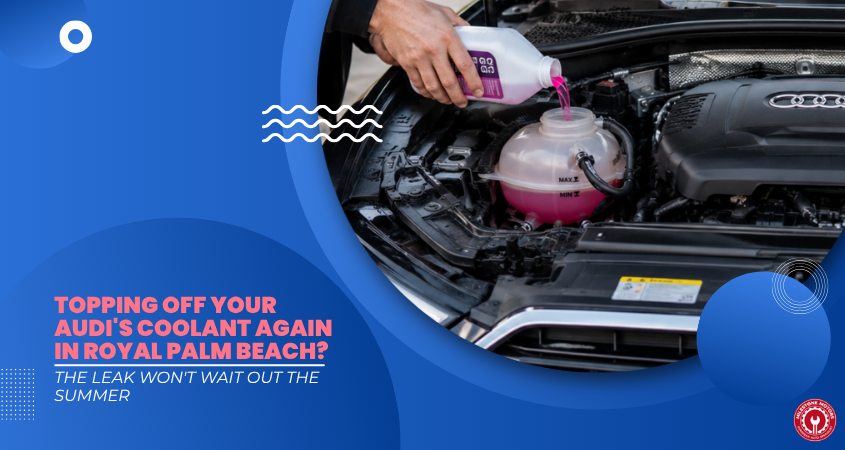
It’s another 93-degree afternoon on Southern Boulevard, an evening storm building to the west, and your Audi’s low-coolant light is on again. You topped it off last week. That repeating message means coolant is leaving the system somewhere, and Royal Palm Beach summer heat is the worst possible time to let it slide.
Audi cooling systems use a lot of plastic, and Florida heat makes that plastic brittle years before it should. A hairline crack in a radiator tank or thermostat housing drips slowly at first, then fails all at once on US-441 in traffic. Milestone Motors works on Audis every day, and we’d rather find that leak now than after it cooks your engine. Get it checked.
Quick Summary: Key Takeaways
- Repeated top-offs mean a real leak: If the coolant light keeps returning, the system is losing fluid, not using it.
- Plastic is the weak point: Audi radiator tanks, thermostat housings, and coolant flanges crack with age and heat.
- Florida heat accelerates it: Constant high temperatures make brittle plastic fail sooner here than up north.
- Low coolant leads to overheating: Run it low, and you risk a warped head and a repair many times the cost of the leak.
- Pressure testing finds it: A proper test pinpoints exactly where the coolant is escaping.
Repeated Coolant Top-Offs Point to a Leak, Not Normal Use
A healthy cooling system is sealed. It shouldn’t need coolant added between services, so when your Audi’s low-coolant warning keeps coming back, fluid is escaping somewhere, either dripping out externally or burning off internally past a gasket. Topping it off treats the symptom and hides the real problem.
That habit is dangerous in summer. Each time the level drops, the system holds less reserve against a hot afternoon on Okeechobee Boulevard, so a slow leak you’ve been managing can suddenly leave you overheating in traffic.
Audi Cooling Systems Have Known Plastic Weak Spots
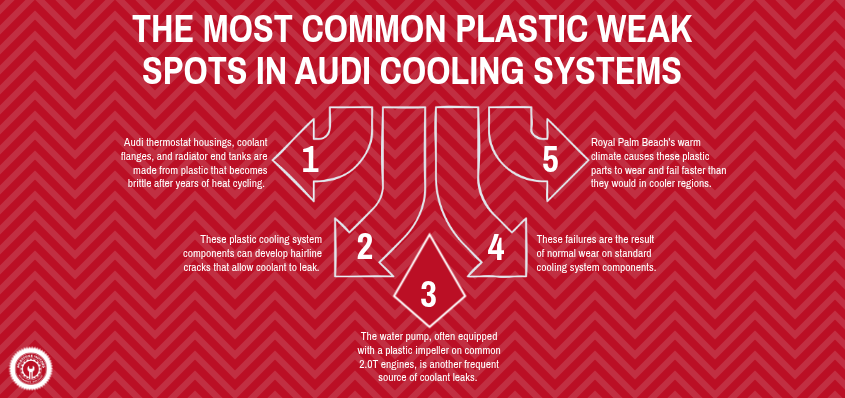
The failure points are predictable on these cars. Audi builds thermostat housings, coolant flanges, and radiator end tanks from plastic that turns brittle after years of heat cycling, and any one of them can develop a hairline crack that weeps coolant. The water pump, often plastic-impellered on the common 2.0T engines, is another frequent leak source.
None of it is exotic. It’s ordinary wear on ordinary parts, and Royal Palm Beach’s climate simply exposes those parts faster than a cooler region ever would.
Constant Florida Heat Ages Cooling Parts Faster
Heat is relentless here. Unlike a car up north that gets a cool season to rest, an Audi in Royal Palm Beach lives with underhood temperatures near their peak nearly year-round, and that steady thermal stress crazes plastic, hardens rubber hoses, and tires out the expansion-tank cap that’s supposed to hold system pressure.
A weak cap alone can cause trouble. When it stops holding pressure, coolant boils at a lower temperature, and the system that coped all winter starts spilling over on the first brutal July day.
Running an Audi Low on Coolant Risks the Whole Engine
Low coolant is not a small thing. Drop below the safe level and the engine simply can’t shed its heat, so temperatures spike, aluminum heads warp, and gaskets let go, turning a cracked $200 coolant flange into a $4,000-plus repair almost overnight. On a turbocharged Audi, heat soak makes it worse. Much worse.
The smart move is early action. Cooling-system failures like a bad radiator, thermostat, or water pump are among the top reasons summer trips end on the shoulder, and AAA expects to rescue 7.7 million drivers at the roadside over the summer. Don’t gamble your engine to save a small repair.
How We Find and Fix an Audi Coolant Leak
We pressure-test first. That pushes the system to normal operating pressure so a slow leak reveals itself, whether it’s seeping from a radiator tank, a thermostat housing, a hose, or the water pump. Factory-level diagnostics tell us if coolant is going somewhere you can’t see, like past a head gasket.
Then we fix it right. We replace the failed part with quality components and refill with the correct Audi coolant specification, never a generic mix, and we retest under pressure to confirm the system is sealed before you drive off.

Why Royal Palm Beach Audi Owners Choose Milestone Motors
We’re an independent European specialist, and Audi cooling work is routine for us. Drivers from Wellington, Loxahatchee, and West Palm Beach bring us their cars because we use factory-grade diagnostic equipment and back qualifying repairs with a lifetime warranty.
You also get loaner vehicles and a shop that explains the problem in plain language. Honest diagnosis, the right parts, and a fix that lasts through a Florida summer.
Frequently Asked Questions
Q: Why does my Audi keep losing coolant in the summer?
A: A repeating low-coolant warning means fluid is leaving the sealed system, usually through a cracked plastic thermostat housing, coolant flange, radiator tank, or a weeping water pump. Florida heat makes those plastic parts brittle and speeds up the failure. A pressure test finds the exact leak point.
Q: Is it safe to drive my Audi if it’s low on coolant?
A: No. Driving low on coolant lets the engine overheat, which can warp the cylinder head and blow the head gasket, turning a small leak into a major repair. If your coolant light is on, top it off only to get somewhere safe, then have the leak diagnosed right away.
Q: What kind of coolant does my Audi need?
A: Audi requires a specific coolant chemistry, and mixing in the wrong type can cause corrosion or sludge over time. We always refill with the correct Audi-spec coolant and pressure-test the system afterward, so you get the protection the engine was designed for.
Stop Topping Off and Fix the Leak for Good
Tired of adding coolant every week? Bring your Audi to us and we’ll find the leak before the heat finds your engine.
Milestone Motors — 530 Business Park Way, Bay 2, Royal Palm Beach, FL 33411
Hours: Monday–Friday, 7:30 AM – 5:00 PM
Website: milestonemotorspb.com